



Got a story worth telling? Be our next guest!
🎙️ Apply now to be interviewed or published on our platform.


 Articles
Beyond survival: how Ukrainian entrepreneurs are reinventing their businesses for global markets
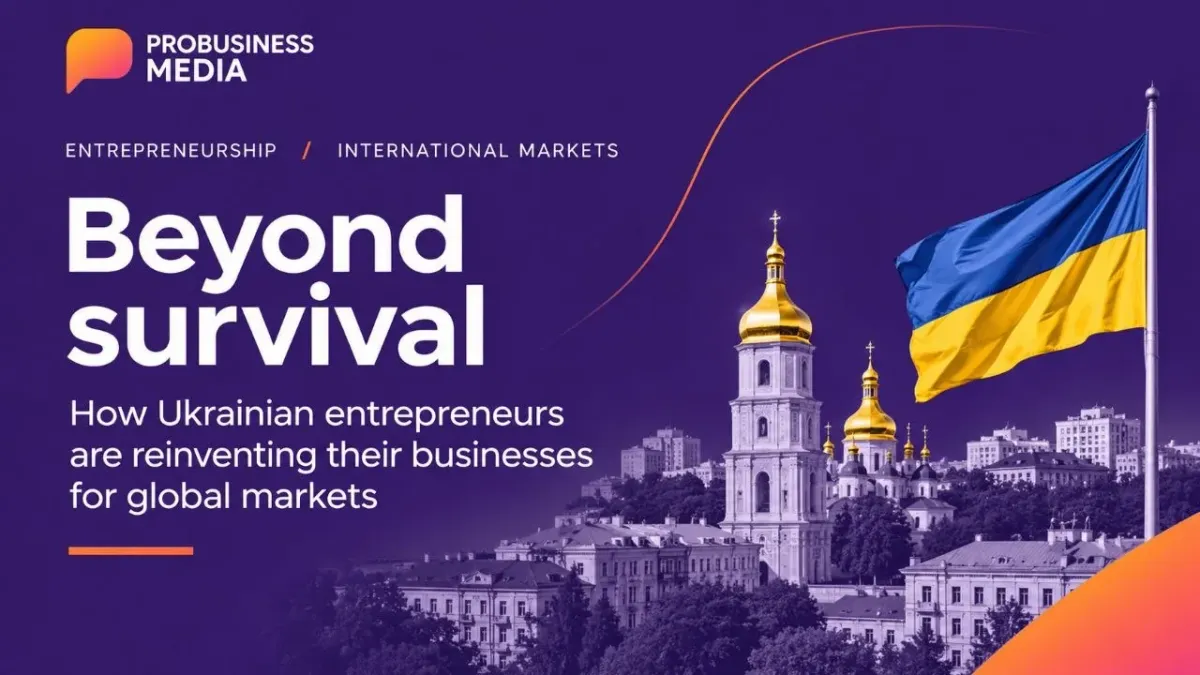
From a delivery company helping to defend its infrastructure against Russian drones to technology firms determined to retain their Ukrainian teams despite international clients’ concerns. From an education business finding an unexpected audience in India to founders building entirely new companies across Europe. Through interviews and first-hand accounts, ProBusiness.Media explores what happens when established business models no longer work, and what entrepreneurs elsewhere can learn from Ukraine’s experience.
At the Kyiv International Economic Forum in October 2026, Viacheslav Klymov, co-owner of the NOVA group, said Nova Poshta had begun countering Russian attack drones, as reported by an Interfax-Ukraine correspondent at the event. For a business built around delivering parcels, helping to protect infrastructure from aerial attacks is hardly a conventional extension of its services. Yet in Ukraine, the boundaries between logistics, energy security and national resilience have become increasingly blurred.
Kyivstar, one of Ukraine’s largest mobile network operators, reports investing billions of hryvnias in energy resilience, including generators and batteries to keep its network running during outages. OKKO, a major Ukrainian petrol station chain, has been installing rooftop solar power systems to reduce its dependence on the national grid. Ajax Systems, a Ukrainian manufacturer of professional security and alarm systems, expanded its international manufacturing footprint by opening a production facility in Vietnam.
These companies are still serving their customers and competing in their respective markets. But they are also solving problems that would have seemed well outside their remit only a few years ago. The same transformation is taking place among smaller businesses, although their stories rarely make international headlines.
Ukrainian technology companies have relocated teams to protect their people and maintain client relationships. Entrepreneurs who spent years serving customers abroad have discovered, after moving to the United States or Britain, that selling to a market from a distance is very different from building a business within it. Meanwhile, founders in Portugal, the Netherlands and elsewhere are launching companies designed for international customers from the outset.
There is more to these stories than resilience in the face of adversity. They reveal how entrepreneurs are rethinking the fundamentals of business: what they sell, who they sell to, how they earn trust, which markets they enter and what resources they need to succeed.
My own business has undergone a transformation I could scarcely have imagined a decade ago. In 2015, I founded Content.UA, a marketing and communications agency. We worked with major corporate clients, including Cisco, Lenovo and OLX, delivering complex business-to-business projects and managing substantial contracts. It was a familiar business model built on our team’s expertise, professional reputation and long-term client relationships. The pandemic, Russia’s full-scale invasion of Ukraine, my move to Portugal and the rapid changes in marketing gradually altered both my business and my understanding of my professional role.
I began spending more time mentoring Ukrainian entrepreneurs, often without charge or for a nominal fee. It was a way to support people trying to preserve or establish businesses in extraordinarily difficult circumstances. But it also taught me something important: many of their problems could not be solved through marketing alone. When a founder said, ‘We need more customers’, the underlying challenge was often quite different. Perhaps the product needed to change, the company was targeting the wrong customers, its positioning was unclear, or it needed new partnerships. Sometimes the entire business model required reconsideration.
Over time, my work shifted from running a marketing agency towards business development and growth strategy. It was not a straightforward story of progress. I had to let go of familiar approaches, reassess my own expertise and rebuild my professional presence in an international environment. That experience made me curious about how other Ukrainian entrepreneurs were navigating similar changes. For this article, I conducted a series of in-depth interviews and collected 13 questionnaire responses from founders and business leaders operating internationally. They represent technology companies, education providers, professional services, financial businesses and consumer brands.
This is a qualitative editorial study, not a representative survey of Ukrainian businesses. Its value lies in the decisions, mistakes and first-hand experiences of people who have had to rethink how they work.
All charts are based on the ProBusiness.Media questionnaire Ukrainian Business in International Markets, completed by 13 people; percentages are shares of the 13 respondents. Multiple answers were possible. The sample is not representative.
One of the most revealing themes to emerge from the interviews was the distinction between serving foreign clients and genuinely understanding a foreign market. For Svitlana Olieinikova, managing partner of the Synergy Universe group, working across borders means understanding not only where funding is available but also what international donors and partner organisations expect. The group brings together grant consultancy, education and other services that help businesses and non-profit organisations secure funding and develop the capacity to use it effectively.
In her questionnaire response, she described a distinction she had learnt first-hand: serving international clients and building a business in those markets require different capabilities. A company can work with American customers for years without understanding how businesses in the United States choose suppliers, establish trust or justify paying a premium. It can deliver projects for British clients without being part of the professional networks through which introductions and recommendations are made.
Anna Kovalova, founder of Anbosoft, a software testing and AI evaluation company, experienced that distinction first-hand. She had been working with international clients for more than a decade, serving businesses in Britain, Australia, Israel, Switzerland, Canada and the United States. On paper, the American market was hardly unfamiliar territory. Yet after moving to California, she discovered how different it was to run a business from within the country rather than serve its customers remotely.
In Ukraine, competitive pricing and reliable delivery had been powerful selling points. In the United States, they were not enough. Personal relationships, professional communities, introductions and credibility established long before a contract is signed all play an important role. Anna began attending conferences, building local relationships and experimenting with ways to meet prospective clients. Some events cost thousands of dollars without generating a single new contract. The experience changed how she thought about business development.
In her questionnaire response, Anna said social media had not yet become a direct source of clients for Anbosoft. Personal contacts, referrals and professional networking remained more effective. She also identified Upwork, the international freelance and contracting marketplace, as a customer acquisition channel. It is an important distinction. A company’s public presence does not always produce immediate enquiries. Sometimes its real value lies in reinforcing trust and keeping the business visible to people who already know it.

Anna Korzh reached a similar conclusion. She co-founded Brainlab, a Ukrainian full-cycle web and software development company founded in 2012, and developed Ellicode, its UK-registered business serving European and British clients. The company began expanding internationally in 2019, but Anna’s move to Britain after the full-scale invasion changed her understanding of the market. She discovered that the British business community was more closely connected than she had expected. Prospective clients attended the same industry events, knew the same people and frequently relied on recommendations.
One of her most expensive lessons came from trying to adapt the company’s marketing. Initially, the team did what many businesses would do: translated its Ukrainian website into English and launched it on a separate domain. But Anna soon realised that British buyers assessed suppliers differently. They compared offers, evaluated prices and made purchasing decisions in ways the original website had not been designed to accommodate. She hired a marketing team through a Ukrainian professional who had lived in London for years, hoping they would help research competitors, refine the company’s positioning and rebuild its online presence.
The exercise cost £8,000 and became one of her most costly lessons in international expansion. The problem was not simply the performance of an external agency. Anna had discovered how difficult it was to outsource positioning in a market she was still learning to understand herself. She also observed that for contracts worth £15,000 or more, personal credibility could become especially important. In her experience, British clients often felt more comfortable dealing with people who understood the local business culture and had established relationships within it.
For Ellicode, international growth became less about translating marketing materials and more about building a local reputation. The company focuses on deep expertise in e-commerce platforms and complex business systems, including ERP, CRM and LMS, for companies at the scaling stage. Two entrepreneurs, working in different areas of technology and on different markets, had reached a similar conclusion: expertise may win the work, but it does not necessarily get you into the room.
For Ukrainian technology businesses, their country of origin has become more than part of their identity. Since 2022, it has also been a factor in international clients’ risk assessments.

When Russia launched its full-scale invasion in February 2022, Langate Group had to protect its employees while continuing to serve clients, primarily in the United States. Iryna Shymko, CEO at Langate EMEA, describes how the company first opened a new office in Chernivtsi, hoping it would help colleagues displaced from Kharkiv reconnect. Few employees chose to settle there, however. The company subsequently opened an office in Lviv, where more of the team had made their new homes.
Iryna recalls that the first messages from overseas clients were about the safety of the team. Within roughly a week, the questions had turned to delivery: when would work resume, and could Langate keep its commitments? Some customers were prepared to consider other suppliers if continuity could not be assured. Langate says it retained all its clients, but doing so required practical arrangements, not simply goodwill.
Langate is an international group of four technology companies with deep expertise in the US healthcare sector, where data protection, regulatory compliance and operational reliability are critical. Its experience shows why retaining a Ukrainian team requires both reliable delivery arrangements and continuing conversations with customers.


Volodymyr Buldyzhov, founder of H-X Technologies, a Ukrainian cybersecurity services company working with international businesses, began addressing operational continuity well before the full-scale invasion. Founded in 2016, the company provides services including penetration testing, security assessments and support with international information security requirements. Even before 2022, H-X Technologies had developed remote working arrangements and considered the risks of a deteriorating security situation. In his questionnaire response, Volodymyr explained that the company strengthened its internal processes and business continuity arrangements, helping it maintain international client confidence.
But having contingency plans is only part of the challenge. Customers also need convincing that those plans will work. For H-X Technologies, professional credentials, recognised standards, transparent communication and client recommendations have become essential to building trust. The company serves markets across Europe, Britain, North America and Asia. Volodymyr notes that Ukrainian cybersecurity expertise can itself strengthen credibility, given the country’s experience of cyberwarfare and the reputation of its specialists. He also points to cultural expectations and communication styles as factors shaping international business relationships.
Anastasiia Bilous, who develops the international technology businesses HitPixel and Vimey, faced another version of the same dilemma. After the invasion, there was pressure to replace Ukrainian developers with specialists based elsewhere. The business chose to retain its Ukrainian teams. For Anastasiia, this was both a difficult operational decision and a matter of principle. The company had prepared options for relocating employees and their families before the invasion. When the fighting began, those plans had to be put into practice.
During our interview, she described the demanding schedules required to meet client commitments while people were relocating and coping with electricity outages. She is open about being Ukrainian, but presents the businesses she works with as international companies operating to global standards. That distinction matters. Ukrainian origins can form part of a company’s identity, but they cannot be its only selling point. Across these three businesses, trust is not built by promising that nothing will go wrong. It comes from demonstrating that commitments can still be met when circumstances become difficult.

Svitlana’s experience offers an unusually clear example. Her grant-consulting business helps organisations obtain funding, but she argues that the deeper work is building their ability to manage and deliver funded projects. According to her account, the business grew threefold during the pandemic and fivefold after the full-scale invasion began, reflecting increased demand for funding expertise and organisational support.
Svitlana, founder of Synergy Development Consulting and managing partner of Synergy Universe, says the group supports businesses and non-profit organisations with grant strategies, applications and the organisational capabilities needed to use funding effectively. Before commercialising her grant consultancy expertise, she had already worked in the field for a decade and helped attract approximately $10 million in funding.
Her advice on resilience is unusually specific: aim for at least seven sources of income, combine online and offline activities where appropriate, and build reserves. She says her group puts aside 10% of incoming revenue and aims to hold enough to cover six months of staff salaries. These are her own operating principles rather than a universal formula, but they show how diversification can become a practical financial discipline.
Her experience is a reminder that grants should not be confused with easy money. Organisational readiness, the quality of a team, a credible market need and the capacity to deliver all matter. For a founder entering a new country, building those foundations can be more valuable than simply identifying the next funding opportunity.

Anton Voroniuk, co-founder of WebPromoExperts, a Ukrainian digital marketing academy, and Skills Booster Academy, an international online education business, began exploring global markets before the full-scale invasion. The initial idea seemed straightforward. The Ukrainian education business was successful, so why not translate its courses into English and offer them internationally? Even that first step proved more complicated than expected. For one course, the team recruited an American voice-over artist who had previously worked as an announcer at basketball games. His deep voice now features in an Excel course and, according to Anton, receives better feedback than courses narrated in Anton’s own English.
The bigger surprises came when the company expanded through Udemy and Coursera, two major global online learning platforms. According to Anton, approximately 25% of Skills Booster Academy’s learners are in India, with around 20% in the United States. The company reports reaching roughly 1.3 million learners across nearly 200 countries. Why India? A substantial share of demand comes from corporate learning subscriptions. Large multinational companies pay for their employees to access educational platforms, and their offices in Indian technology centres such as Bengaluru employ thousands of people undertaking professional training.
Course providers can receive payments based partly on how much of their content is watched. As a result, a single corporate customer can produce a sudden surge in viewing figures. Anton remembers one such spike originating from the Colombian office of Publicis, the international advertising and communications group. But global audiences also produce unexpected complications. English-language courses receive reviews in Korean, Spanish, Italian and numerous other languages. More surprisingly, a poor rating does not always mean the learner disliked the teaching.
Anton has noticed that employees sometimes resent being required to undertake corporate training during the summer, when they would rather be on holiday. That frustration can find its way into a course review. As he puts it, when people want to take a holiday but are told they must study, they may take their frustration out on the course they have been assigned. For a business accustomed to controlling its marketing and sales, this was a different world. Success on a global marketplace depends partly on corporate purchasing decisions, platform algorithms and the behaviour of learners whom the course provider may never meet.
Initially, Anton tried to reproduce the Ukrainian business structure, where product development, marketing and sales were equally important. Eventually, he realised that the international marketplace required a different approach. The platform was already responsible for much of the customer acquisition. His team needed to concentrate on producing courses that matched demand. Anton compares the strategy to venture investing. A business might launch ten courses, find that nine attract little attention and discover that one suddenly takes off. The challenge is to recognise the successful product quickly and put more resources behind it.
Even experienced teams cannot always explain precisely why one course succeeds and another does not. The change was therefore far more significant than translating course materials. Skills Booster Academy had to adopt a different commercial model. A similar reassessment is under way at Brainlab. The Ukrainian development company has been operating for more than 14 years. It has weathered several crises, built financial reserves and learnt to work remotely. Yet a new challenge is emerging.
In Britain, Ukrainian software development companies compete with suppliers in India and other Asian markets, where prices may be lower. Historically, higher-quality work was an argument for choosing a more expensive development team. But AI tools are enabling less experienced specialists to complete some routine tasks more quickly. That is putting pressure on a familiar competitive advantage. Companies selling software development services increasingly need to offer something harder to replace: specialist expertise, a deeper understanding of the customer’s business, responsibility for outcomes or the ability to solve complex problems.
Anton’s and Anna’s experiences point to the same lesson. International competition often requires companies to reconsider what customers are actually paying for, rather than simply changing how they advertise.
Not every entrepreneur in this study moved an existing business abroad. Some founded their companies after relocating. Their stories challenge the familiar narrative of a Ukrainian business ‘expanding internationally’. For these founders, the international market was the starting point.
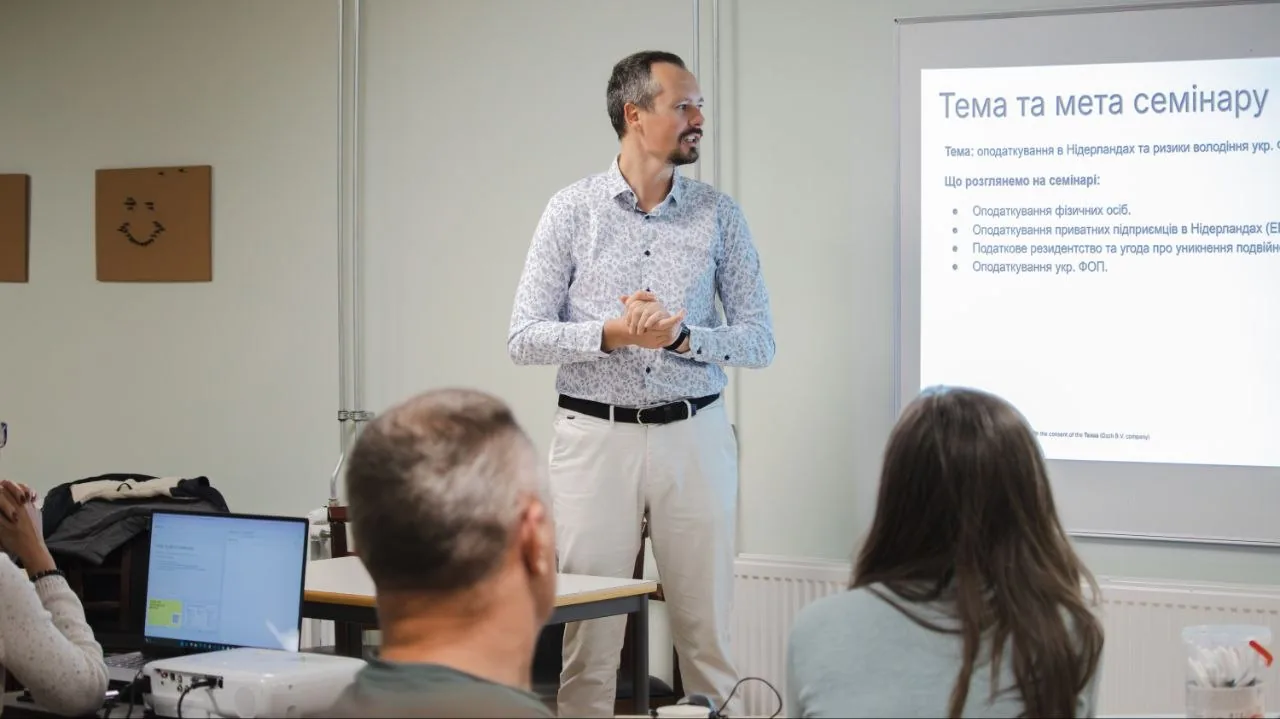
Dmytro Levchun co-founded Taxua, a bookkeeping and tax support service for entrepreneurs in the Netherlands, in response to a specific need in the local market. Rather than copying an existing business model, the team decided to look at bookkeeping through the eyes of IT professionals and build the best possible combination of technology and accounting expertise — essentially, boekhouding as a service.
Trust proved particularly important in financial services. Dmytro had experience building communities and used it to establish a professional network around tax and accounting questions. Customers come through Telegram communities, personal recommendations and existing clients. He also described free educational events as a way to introduce prospective customers to the service. But the most revealing part of Taxua’s story is its operating model. Dmytro half-jokingly describes the team as “lazy accountants” — the kind who would rather spend a day building a tool than an hour repeating the same task every month.
When clients began issuing invoices in US dollars, the company needed to convert the amounts into euros using the appropriate European Central Bank exchange rates. Rather than checking the rate manually for every transaction, the team built automated currency conversion into its own system. On another occasion, the team calculated that the commercial WhatsApp arrangement it needed would cost approximately €300 a month. Instead, it developed an internal tool using the official WhatsApp Business API, reducing recurring costs and giving the business more control over the functionality.
Yet the biggest challenge turned out to be the human side of accounting. Initially, Dmytro expected automation to reduce the time an accountant spent on each client to just one or two hours a month. Reality was more complicated. Documents varied, customers needed explanations, and AI could not always extract information reliably without human checks. Taxua’s model now combines affordable pricing, automation and human quality control.

Olha Arkusha, founder of Qoolli Software Testing and Qoolli Academy in the Netherlands, took a different route. With a background in software quality assurance, including work on a project at the Dutch Ministry of Foreign Affairs, she initially intended to build a business providing testing services to companies. Then people began asking her to teach them how to become software testers. Rather than insisting on the original business plan, she decided to test the demand.
The first two groups studied free of charge. For the third, Olha introduced a fee of €25, primarily to establish whether people were willing to pay at all. Forty people enrolled. Across the first three groups, 120 people participated in the training in total, including the 40 paying participants in the third group. But the next intake was considerably smaller, demonstrating that one successful launch does not guarantee consistent demand.
Olha began developing a more structured sales approach and reconsidering how the academy attracted students. She has not abandoned her original ambition to serve business clients. The academy could also become a source of trained specialists for future contracts with Dutch companies. What began as a departure from the business plan may therefore become part of the longer-term strategy. Another example comes from Portugal. Anastasiia Hrynchuk founded FLÉX, a women’s activewear brand, in 2025.
From the beginning, FLÉX was intended for an international audience rather than solely for Ukrainians living abroad. The brand operates at the intersection of fashion, fitness and wellbeing, producing clothing for Pilates, yoga, exercise and everyday active lifestyles. For a young consumer brand, establishing trust in a crowded market is a major challenge. Anastasiia found that conventional advertising was less effective when customers had never encountered the brand before. Relationships with local studios, trainers, events and communities were more promising.
Customers wanted to see the clothing on real people, try it on and judge the quality for themselves. For FLÉX, partnerships and face-to-face interaction became part of customer acquisition rather than optional promotional activities. These three businesses operate in very different sectors, but share a defining characteristic. Their founders did not begin by asking how to transfer a Ukrainian business model abroad. They started by identifying a need in a particular market.

Nadiia Kuzmenko took a different route into international business. A writer and writing mentor, she founded her own publishing house in April 2024 after deciding that the services available to her as an author did not meet her needs. Her business combines writing mentorship with publishing, allowing clients to work on a manuscript and then bring it to print with the same team. She moved from Ukraine to Bulgaria in 2022 and later chose Portugal as her new home.
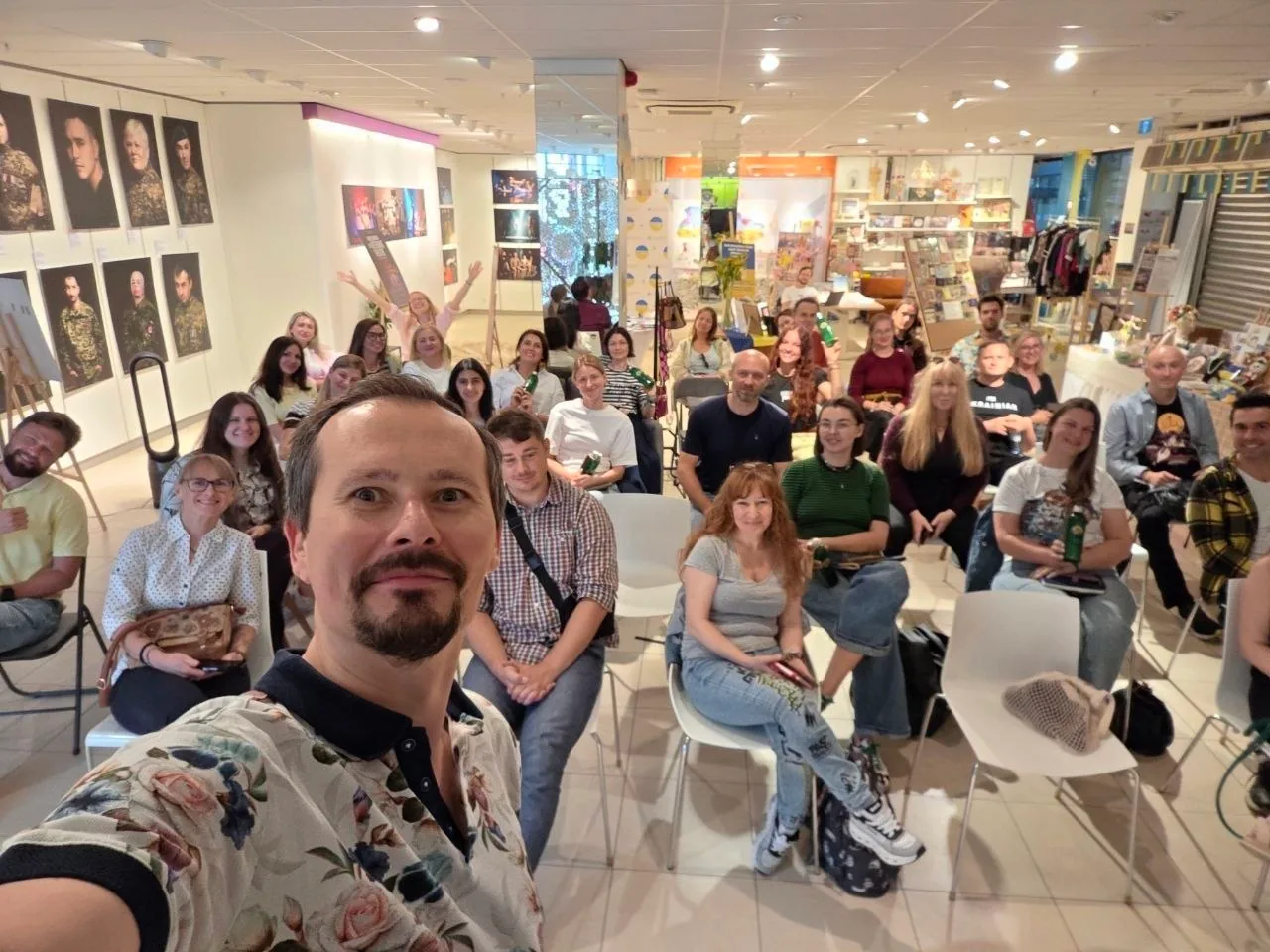
At a Lisbon presentation on 1 October, she brought together around 40 guests, including authors and partners. At the time of the interview, her publishing portfolio was approaching 20 books. She also described how expert-led books can help professionals build communities and develop new services, although she cautioned that the commercial impact of recently published titles was still too early to measure.

Sofiia Kekukh is the founder of Senses Speaking Club, a UK-based education business that brings together English language learning, confidence-building and public speaking. The club empowers ambitious individuals to communicate with confidence, express themselves freely and unlock new opportunities through language. Most of its members are Ukrainian, although the business has started attracting international clients through professional networks and referrals.
Sofiia has experience working with international organisations and has studied at the London School of Economics and Political Science (LSE) and the University of Toronto. She considers her professional background and reputation important sources of credibility.
The business is still exploring which customer acquisition channels work best. One distinctive initiative is Military English for Defenders, a set of English lessons developed for Ukrainian service personnel. Her experience demonstrates that international expansion does not necessarily mean abandoning Ukrainian customers. A business can serve its community, respond to needs in Ukraine and gradually broaden its international audience.

The founders of retreefy, Anton Yurash and Liuba Shlapai, have chosen another route. They are developing an AI-powered software-as-a-service product in the wellbeing and personal development sector, with the United States as their intended market from the outset. Rather than building for Ukraine first and adapting the product later, they chose to identify their target market at an early stage. They were attracted by the scale of the American market and consumer interest in AI-based products.
However, retreefy is still validating its product and preparing to enter the market. In their questionnaire response, the founders identified company registration and payment arrangements among their challenges. Advertising and social media promotion remain plans rather than proven sales channels. International ambition should not be confused with international success. The value of this example lies in the founders’ approach: testing assumptions about a particular audience before committing substantial resources to marketing.
For an early-stage business, discovering that customers are unwilling to pay after building the entire product can be far more expensive than testing demand early.
One of the most practical parts of the research concerned customer acquisition. I asked entrepreneurs which channels were working, which were becoming less effective and what they had stopped doing. The answers offered little support for the idea of a universal international marketing formula. For H-X Technologies, content marketing, media coverage, partnerships, referrals and search visibility remain important. Volodymyr Buldyzhov also believes that conventional search engine optimisation is becoming less effective, while visibility in AI-powered search is increasingly relevant.
Anastasiia Bilous, of HitPixel and Vimey, sees a similar shift. In her view, people are increasingly obtaining answers directly from AI services, making traditional organic search traffic less predictable. For Anna Korzh at Brainlab and Ellicode, LinkedIn, recommendations and local professional relationships have become more valuable than large-scale cold email campaigns. For Dmytro Levchun at Taxua, communities and personal referrals are particularly effective. For Anastasiia Hrynchuk at FLÉX, partnerships with trainers, local events and opportunities for customers to experience the product in person are essential.
Other participants reported different approaches. BL PUBLISH, a business that helps companies create and publish books as a marketing tool, uses content, direct outreach and face-to-face networking. Its representative noted that Threads, Meta’s text-based social platform, was no longer delivering the desired results with English-speaking audiences. Understanding how international customers make purchasing decisions remains a central challenge.

In financial planning, Lyubomyr Ostapiv, a partner at iPlan and founder of Simeinyi Biudzhet, reports that referrals accounted for around 20% in 2026. The service continues to rely on content and recommendations as it develops its international activity. International growth has also increased marketing costs and made in-person events more complicated to organise. Iryna Shymko at Langate Group likewise reports declining effectiveness from cold email outreach and advertising. None of this proves that advertising, search optimisation or outbound sales have stopped working. It demonstrates something more useful: a channel’s effectiveness depends on the business model, the market, the level of trust required and the way customers make decisions.
Referrals and partnerships appear particularly important for complex B2B services, even when companies have sophisticated digital marketing capabilities. That reflects what I see in my own consulting work. Businesses frequently invest in marketing before establishing who actually makes the purchasing decision, why a customer would replace an existing supplier and what evidence would persuade them to trust someone new. Without those answers, increasing the marketing budget may do little to improve sales.
This is where much of my work now begins: helping founders test demand before they invest in scaling, decide when a pivot is needed and find out why something that should be working is not. Once the direction is clear, my agency team at Content.UA takes care of execution, from content marketing and distribution to account-based marketing (ABM) and partner integrations. If your business is facing a similar question, tell me about it.
All 13 questionnaire respondents reported using AI in their marketing or business processes. Eleven said they used it actively for content and analysis, while two used it occasionally for routine tasks.
All charts are based on the ProBusiness.Media questionnaire Ukrainian Business in International Markets, completed by 13 people; percentages are shares of the 13 respondents. One answer per respondent. The sample is not representative.
The more interesting changes, however, are occurring where AI affects the product itself. Anna Kovalova’s Anbosoft is developing AI evaluation services alongside conventional software testing. It is a revealing example. A technology that automates some existing work simultaneously creates new demand for quality assurance. Companies need specialists who can assess whether AI systems behave reliably, meet business requirements and respond appropriately in unexpected situations. For Anna Korzh, AI presents a different challenge.
If higher-quality work once helped justify the cost of experienced development teams, new tools are now allowing less experienced specialists to complete some routine tasks more efficiently. That intensifies price competition. Iryna Shymko has also described the need to train Langate Group employees in AI to maintain the company’s competitiveness.
For Langate Group, whose expertise includes technology for the US healthcare sector, the next challenge is not only geographic. Iryna Shymko believes artificial intelligence is pushing technology suppliers to reconsider the traditional practice of charging for developers’ hours. She expects more services to be packaged around specific customer problems and outcomes, while acknowledging that the industry has yet to settle on a new model. At Taxua, automation already affects the cost of delivering services. But Dmytro Levchun’s experience also illustrates its limitations: accounting documents remain inconsistent, and automated extraction is not always reliable enough to remove human verification entirely.
AI is therefore creating new markets while reducing the commercial value of some traditional services. For entrepreneurs, that raises an uncomfortable strategic question: if customers can automate much of what they currently pay for, what will they be willing to buy tomorrow? Increasingly, the answer may lie less in carrying out individual tasks and more in understanding business problems, integrating solutions and taking responsibility for outcomes.
Another question in the research concerned misconceptions about Ukrainian businesses. I expected to hear numerous stories about mistrust caused by the war or stereotypes surrounding Ukrainian professionals. The responses were more nuanced.
Volodymyr Buldyzhov of cybersecurity company H-X Technologies offers a useful counterpoint to a familiar discussion about national stereotypes. In cybersecurity, Ukrainian expertise can be an advantage: the country’s experience of cyberwarfare and the international reputation of its technical specialists can strengthen credibility. Yet he also draws attention to cultural expectations. In his view, the stereotypes Ukrainian professionals encounter in Western markets may concern communication styles and business culture more than the quality of their services. As people become more familiar with Western professional norms, some of these barriers may diminish.
Sofiia Kekukh did not identify a particular misconception she regularly had to challenge either. Anastasiia Bilous, however, sees one assumption as especially important: that Ukrainian teams can only perform effectively under stable conditions. Her response is not a publicity campaign. It is the work her teams continue to deliver. Dmytro Levchun says local Dutch entrepreneurs are often struck by how fast Ukrainians get a business off the ground — and by the standard of service they deliver.
Anastasiia Hrynchuk challenges another assumption: that Ukrainian businesses established abroad must be aimed at the diaspora or sell products associated with Ukrainian identity. FLÉX was designed for an international consumer from the beginning. Iryna Shymko points out that sometimes the issue is not prejudice but limited knowledge of Ukraine. At the same time, Langate Group faces entirely practical concerns about employing teams in a country at war. These are different problems and require different responses.
Prejudice can be challenged through professional credibility and successful projects. Operational risks must be addressed through practical business continuity measures. Confusing the two is unlikely to help.
Comparing these experiences, I was struck by how many of the lessons extend well beyond the war. Svitlana Olieinikova shows how diversification and reserves can become operating disciplines. Volodymyr Buldyzhov demonstrates the value of preparing for risks early and working to recognised international standards. Iryna Shymko shows why businesses need the ability to relocate teams and maintain service continuity. Anastasiia Bilous reminds us that retaining people can be a strategic decision as well as an ethical one.
Anna Kovalova and Anna Korzh illustrate why international markets must be understood from within. Having overseas customers does not necessarily mean understanding how local buyers make decisions. Anton Voroniuk shows that scaling internationally may require a completely different business model, not simply a translation of an existing product. His experience with corporate learners in India demonstrates how little a company may initially understand about the behaviour of its global audience.
Dmytro Levchun, Olha Arkusha and Anastasiia Hrynchuk offer another perspective: the possibility of building new companies around specific needs in international markets, drawing on skills and experience developed elsewhere. Meanwhile, the experiences of Anbosoft, Brainlab, Ellicode and Langate Group suggest that technological change can disrupt a business model just as profoundly as geopolitical events. Taken together, these stories suggest that businesses should regularly challenge not only their financial resilience but also their assumptions about the market.
Will demand for the product survive a technological shift? Could the team operate from another country? Are there alternative sources of customers? Does the company understand how buyers make decisions in its target markets? And how much of its business depends on resources or platforms beyond its control? These questions cannot prevent the next crisis. They can, however, reveal vulnerabilities before they become existential threats.
When I began this research, I wanted to understand how Ukrainian entrepreneurs had adapted to new circumstances. After speaking to them, I realised that adaptation did not quite describe what had happened. Many had done more than change processes or move to another country. They had reconsidered what their businesses were for, who their customers were, what risks they could accept and even how they saw themselves professionally. For some, that meant entering international markets. For others, it meant starting a company from scratch after relocating. Some abandoned familiar sales models. Others chose to retain their teams even when partners or clients wanted them to do otherwise.
My own experience has been part of the same transformation. I moved from running a marketing agency with major corporate contracts, through mentoring Ukrainian entrepreneurs, to advising companies on business development and growth strategy. I now see that this shift was not simply a reaction to external circumstances. It forced me to think more carefully about how businesses create value, why established models stop working and how entrepreneurs recognise opportunities they might previously have overlooked.
I heard versions of that story throughout the interviews. Ukraine’s entrepreneurial experience should not be romanticised. Behind it are losses, expensive mistakes, difficult decisions, disruptive relocations and years spent rebuilding. Yet it offers something valuable to business leaders far beyond Ukraine: practical experience of reconsidering a business when familiar assumptions can no longer be relied upon. Perhaps the most important lesson is that a company’s resilience should not be measured solely by its ability to return to the way things were.
Sometimes returning is impossible. Sometimes it is not even desirable. What matters more is understanding what the business needs to become in order to remain relevant in a world that has changed.
About the research. This article draws on a series of in-depth interviews with Ukrainian entrepreneurs and 13 responses to ProBusiness.Media’s editorial questionnaire, “Ukrainian Business in International Markets”. The findings reflect participants’ individual experiences and should not be interpreted as representative statistics for Ukrainian entrepreneurship. Interview remarks originally given in Ukrainian have been translated and edited for clarity.
Figures reported by participants have not been independently audited.
Explore more conversations about the people, decisions and systems behind growth.

Got a story worth telling? Be our next guest!
🎙️ Apply now to be interviewed or published on our platform.
Subscribe now for exclusive content and expert insights. Be the first to stay informed!

Probusiness Media is an independent editorial platform that explores the stories, strategies, and systems behind conscious entrepreneurship in times of change.
Where stories, strategy, and meaning come together.