


Got a story worth telling? Be our next guest!
🎙️ Apply now to be interviewed or published on our platform.


 Articles
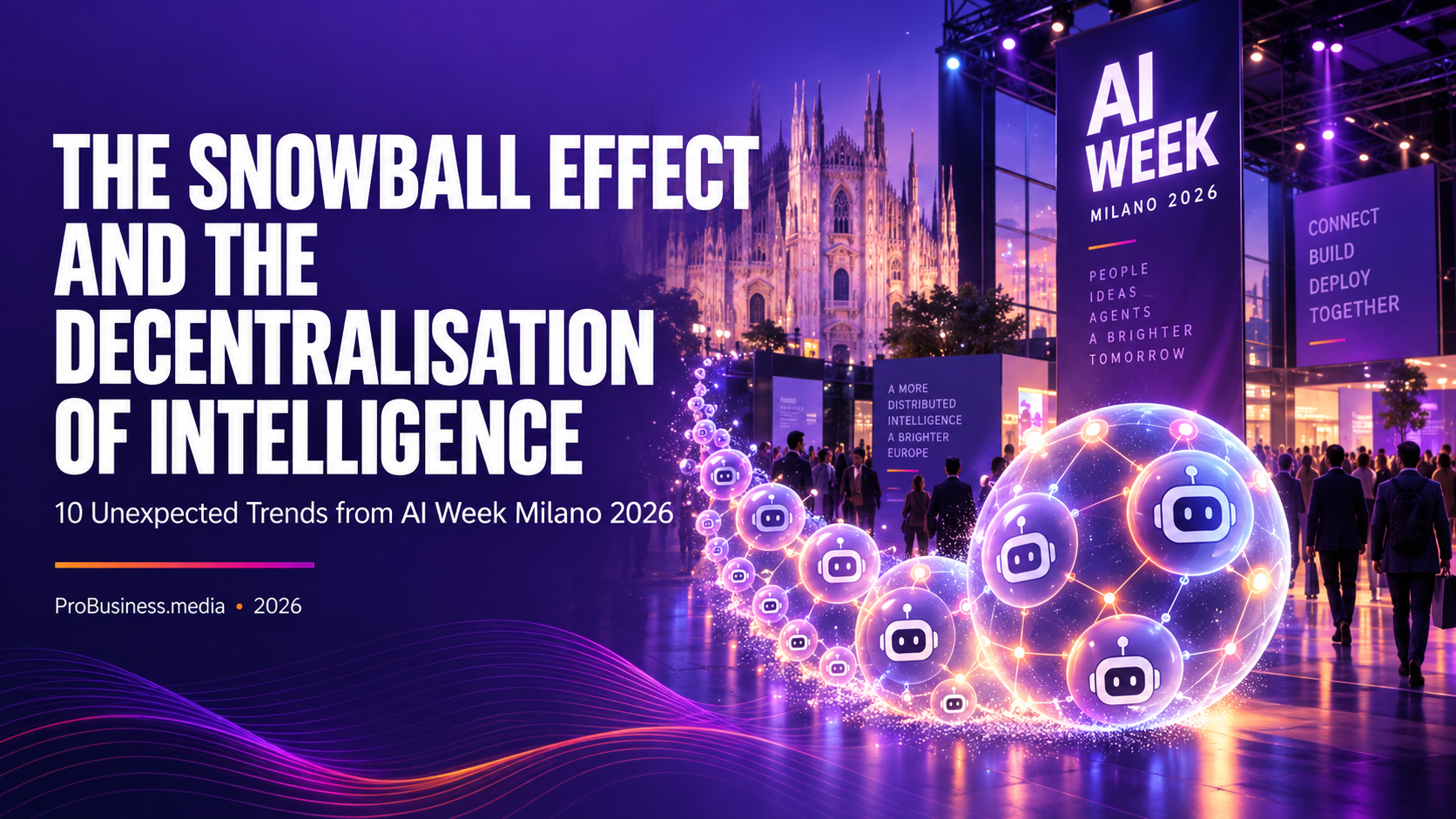
The Snowball Effect and the Decentralisation of Intelligence: 10 Unexpected Trends from AI Week Milano 2026
Articles
The Snowball Effect and the Decentralisation of Intelligence: 10 Unexpected Trends from AI Week Milano 2026
Author: Evgenia Rodionova, Marketing expert, Business Development Mentor, AI & Digitalization Strategist, and Co-owner of ProBusiness.media
The business world has definitively crossed the point of no return, where artificial intelligence was merely an expensive experiment reserved for large technology corporations. The seventh annual European AI Week Milano 2026 conference, held on 19–20 May at Fiera Milano Rho, demonstrated the scale of the tectonic shifts currently reshaping the industry.
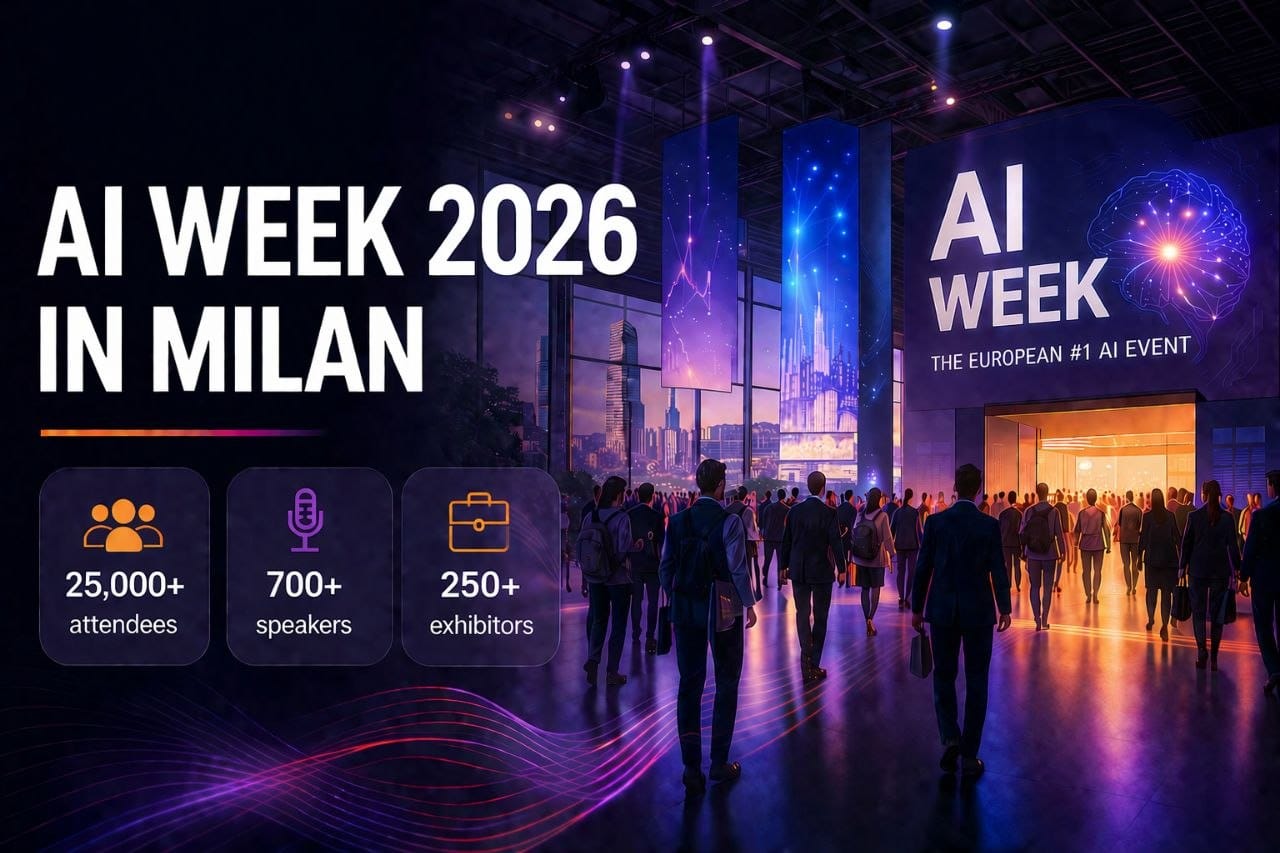
The event attracted a record 29,285 attendees, featured more than 700 international speakers across 17 stages, and brought together participants from more than 70 countries, cementing its position as one of Europe’s leading platforms for examining the impact of generative and autonomous technologies on the global economy.
Experts compare the current stage of technological development to a ‘snowball effect’: every week, the momentum increases exponentially, rapidly transforming the world we are accustomed to.
Only a few years ago, businesses were discussing generative AI primarily as a tool for instantly producing content, text or images. Today, we are experiencing a much deeper transformation. Traditional language models are giving way to the era of Agentic AI: autonomous agents that do not simply answer questions, but act on our behalf, independently planning, making decisions and completing end-to-end business tasks with little or no human involvement.
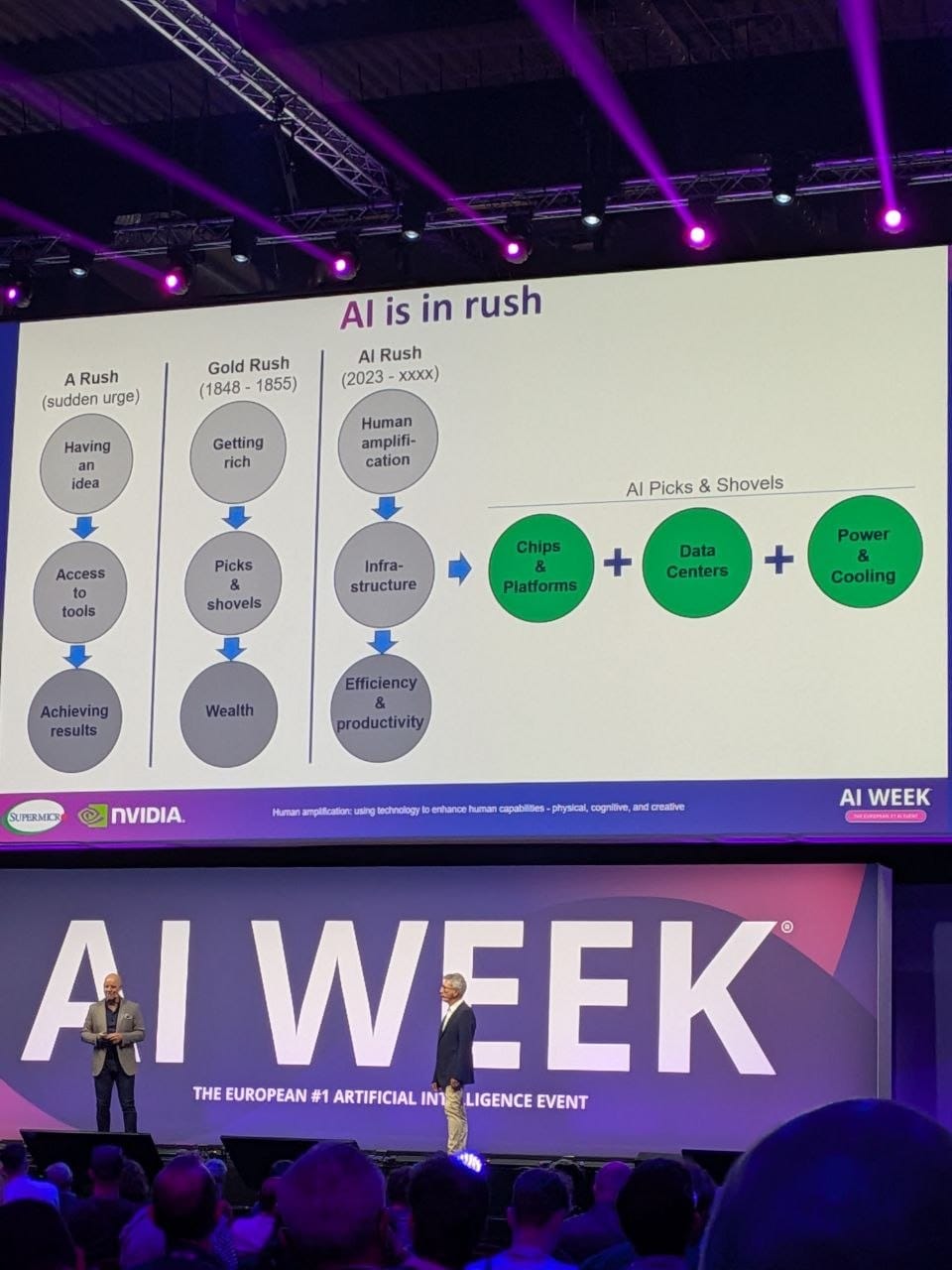
The main conclusion from AI Week Milano 2026 is clear: nobody is seriously asking whether AI works any more. Businesses are now facing an entirely different set of challenges: building sophisticated infrastructure, finding the right balance between Western and Eastern technology stacks, and addressing the ethical challenges created by the mass adoption of autonomous systems.
We analysed dozens of discussions, presentations and conversations taking place around the conference and identified ten less obvious trends that are already beginning to shape the development of technology and business over the coming years.
One of the most striking observations from the AI Week Milano 2026 exhibition was the extent to which Ukrainian developers and specialists are integrating into the global technology market and building internationally competitive products.
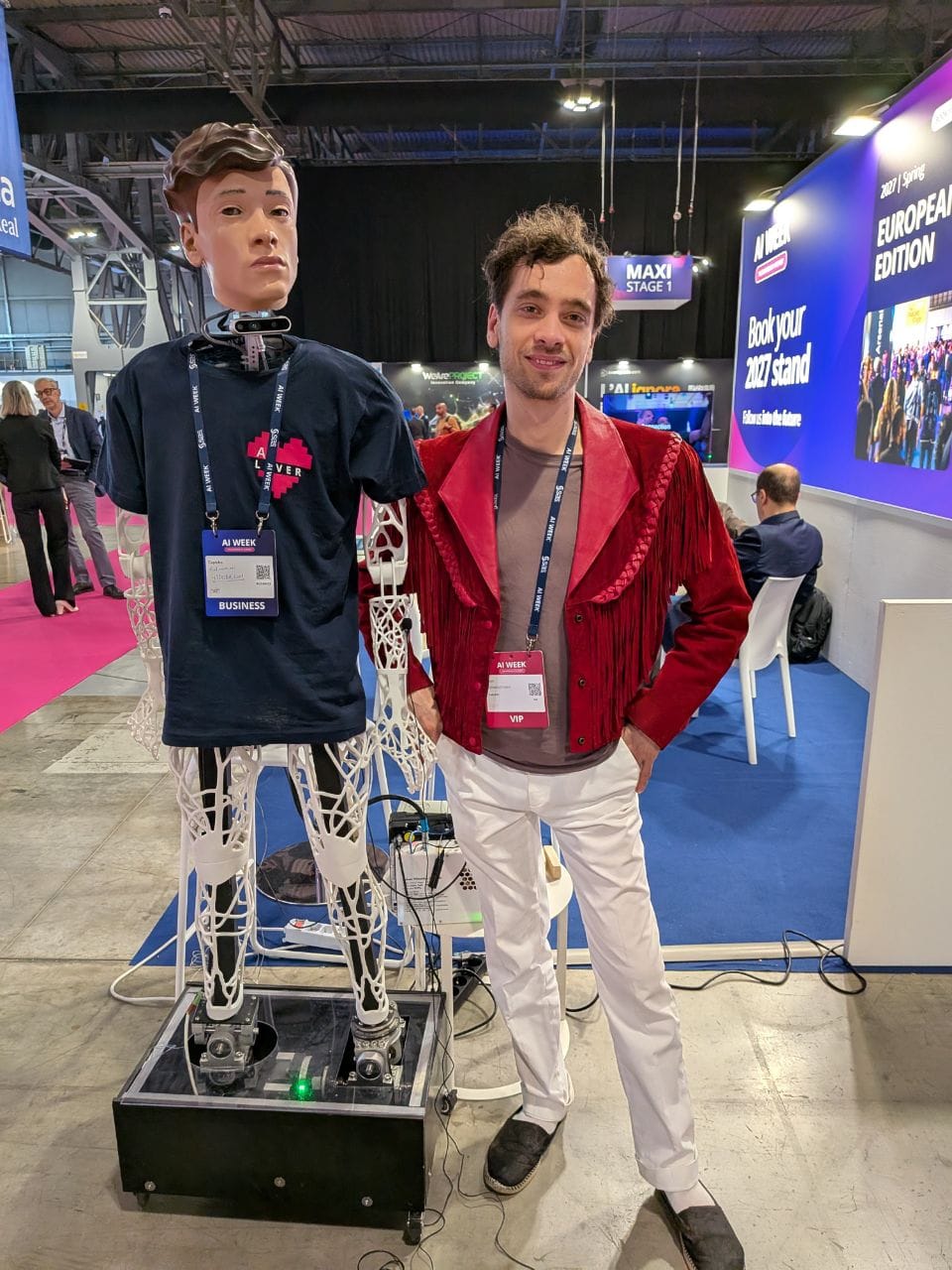
Ukrainian developer Vlad Grankovsky, co-founder of AI and robotics company Hidoba Research, attracted particular attention from the European business community.
At the conference, he presented Captcha, a humanoid robot which, according to Grankovsky, had been in development for four years. Captcha became one of the exhibition’s most effective attention-grabbers. Grankovsky told ProBusiness.media that over the previous year the team has significantly upgraded the system, adding support for new languages, improving its Text-to-Speech module, increasing the robot’s overall intelligence and enabling seamless switching between languages in real time.
The Ukrainian start-up’s business model reflects the realities of today’s market remarkably well. Grankovsky says the company deliberately avoids building its business around selling physical robots, as this would create additional operational complexity. Instead, Hidoba Research commercialises its conversational AI technology through APIs, SDKs and edge licensing.
The technology could address one of the fundamental problems of modern management: the shortage of time. Rather than remaining constantly available and personally answering every customer call, an entrepreneur could delegate much of this work to a personal digital twin. Such a digital counterpart could handle routine negotiations, support transactions and administer processes, allowing people to focus on strategic work where human judgement remains most valuable.
At the same time, the rapid rise of solopreneurship was widely discussed throughout the summit. Ukrainian freelancers, many of whom shifted to remote work during the pandemic, are increasingly becoming fully fledged business units in their own right.
As developer Oleksandr Neliubov points out, by combining several AI agents, a single founder can now manage processes that previously required an entire team, from automating marketing CRM systems and preparing payment documentation to making cold calls and conducting legal analysis of contracts.
While Western developers and vendors remain focused on increasing the raw computational power of models such as Anthropic’s Claude and OpenAI’s GPT, China is demonstrating a fundamentally different and more pragmatic approach to building its artificial intelligence ecosystem.
One of the central events on the conference’s technology stage was a presentation by Alibaba Cloud, showcasing its flagship Qwen family of models, including Qwen 3.6 Plus, as well as the Wan 2.7 multimedia platform.
Chinese developers are following a methodology reminiscent of the country’s automotive expansion: carefully analysing what others have done, learning from their mistakes and optimising architecture. Rather than competing only on raw scale, Chinese vendors are increasingly focusing on efficiency, deployment cost and model specialisation.
Against the backdrop of a global shortage of data-centre capacity and energy resources, energy consumption is becoming a critical factor in technology procurement decisions.
The Chinese technology stack demonstrated several major advantages at AI Week 2026.
A vast context window. Qwen 3.6 Plus supports a context window of one million tokens, equivalent to roughly 750,000 words of ordinary human language. This allows the model to process very large bodies of information within a single context, reducing the need to split complex documents or workflows across multiple sessions.
Professional specialisation. Rather than relying on a single universal model, Alibaba Cloud offers a family of specialised solutions, including Qwen-MT for machine translation, Qwen-Math for mathematical reasoning, Qwen-Embedding for search and information retrieval, and Qwen-Coder for autonomous software engineering.
Deep open-source development. The Qwen family has developed into one of the world’s largest open model ecosystems. By the time of the conference, the Qwen ecosystem had surpassed one billion downloads and more than 200,000 derivative models, while Alibaba had open-sourced more than 400 models across its broader AI portfolio.
In addition, Alibaba Cloud is building a complete Model-as-a-Service infrastructure through its Model Studio platform.
As European experts at the conference, including Daniele Iandolo, Senior Manager at KPMG, and Fabio Cencioni of Tucano Srl, emphasised, one important factor for European customers is the availability of Alibaba Cloud infrastructure in Frankfurt. Model Studio also offers an EU deployment scope that can restrict inference to the European Union, an important consideration for organisations with data-residency and compliance requirements.
China is therefore not merely offering the AI ‘brain’. It is supplying a complete operational ecosystem, including data storage and high-speed GPU clusters.
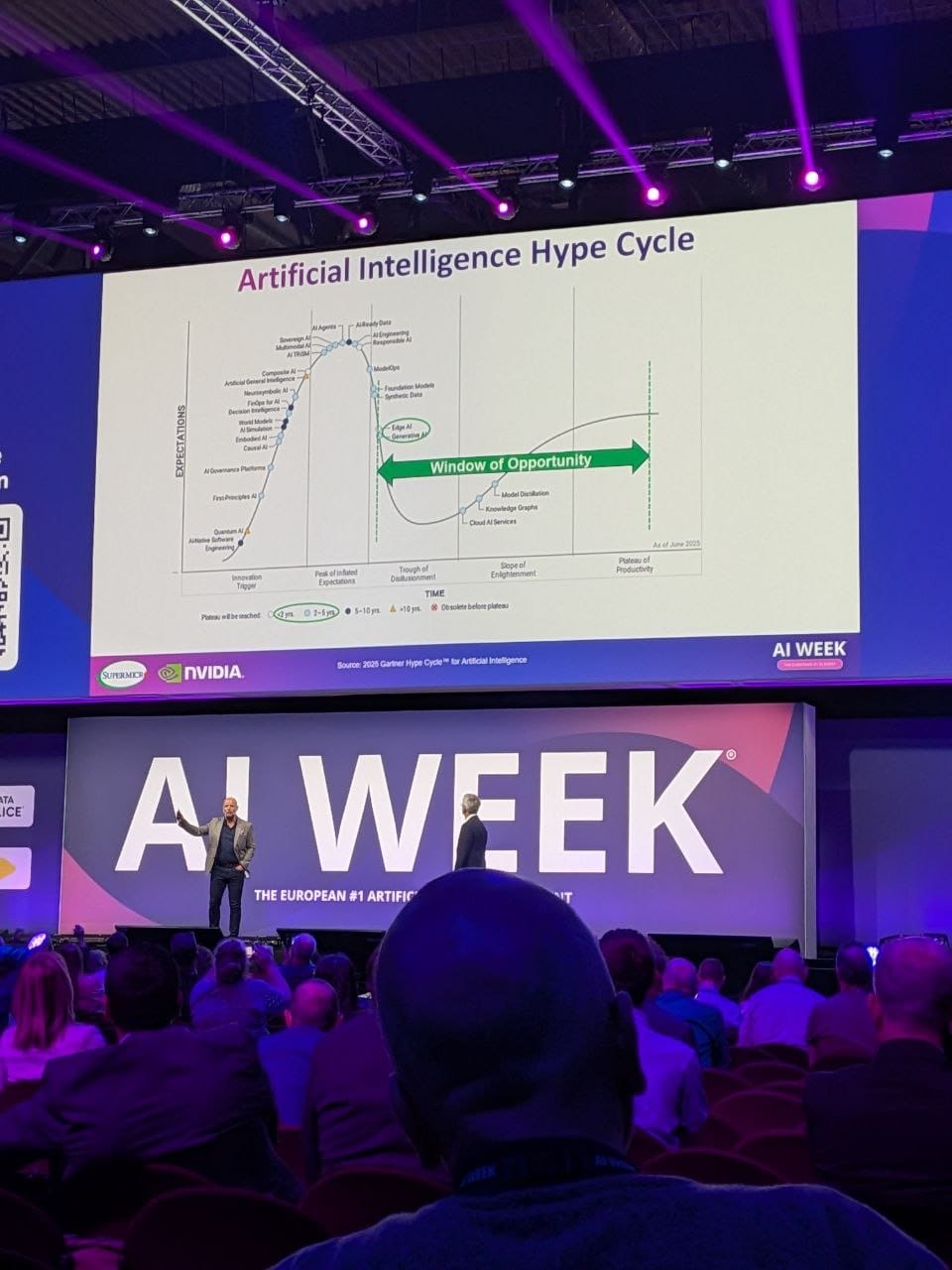
A deeper analysis of conversations behind the scenes, presentations across the conference stages and practical business cases reveals ten less obvious but fundamental trends that are likely to shape the business landscape over the coming years.
According to Oleksandr Neliubov, part of what users experience as capability limits may increasingly reflect deliberate safety restrictions rather than purely technical constraints.
This is driven not so much by technical server limitations as by growing concerns within the cybersecurity sector.
Advanced models are becoming increasingly capable of identifying software and cryptographic vulnerabilities, intensifying concerns about how unrestricted frontier capabilities could be misused in sensitive systems.
This helps explain why frontier AI developers are introducing additional safeguards, access controls and restrictions around high-risk capabilities.
Perhaps the most underestimated risk associated with AI integration is not job displacement, but the gradual decline in people’s willingness to exercise their own critical judgement.
Ethics discussions at the conference highlighted a growing tendency among business leaders and managers to delegate increasingly important decisions to machines, effectively outsourcing elements of their intuition, worldview, convictions and even identity.
Society may soon need tools capable of monitoring ‘trust drift’: the point at which a person begins to trust an algorithm more than their own judgement.
A radical reversal of roles is taking place in industrial and logistics robotics.
Experts argue that the humanoid robot itself is increasingly becoming the customer, while the company becomes its supplier.
Industrial environments require highly specific training data that simply do not exist in publicly available datasets. Companies therefore need to create their own proprietary datasets in order to ‘grow’ the digital intelligence of a robot.
Once developed, this intelligence can potentially be transferred between physical platforms produced by different hardware vendors.
The “AI tax” is moving from a theoretical debate toward discussions about how the gains from automation should be redistributed. South Korea offers an interesting precedent: it previously reduced tax incentives for automation investments, and in 2026 the country’s labour minister publicly urged major technology companies benefiting from the AI boom to share excess profits with workers, suppliers and local communities.
AI is finding an unusual application in reminiscence therapy for people living with dementia and Alzheimer’s disease, as well as among migrant communities whose homes have been lost through war or natural disasters.
Rather than generating perfect, photorealistic HD images, developers are using AI models to reconstruct subjective memories.
During an interview, a person gradually adjusts the prompt and restores details from childhood: the colour of the walls, clothing, furniture or the architecture of a balcony.
The process has shown considerable therapeutic potential and may help stimulate cognitive functions by encouraging people to actively reconstruct their own memories.
Technologies for mass surveillance and behavioural analysis, once largely controlled by governments and intelligence agencies, are increasingly becoming publicly accessible instruments of accountability.
At the conference, open models were demonstrated that can analyse live video feeds from parliaments and government buildings in real time, identifying, for example, precisely when and which politician fell asleep during legislative proceedings.
As Flavio Fulciniti, Creative Director at Media Engineering srl, observed, this reverses the traditional logic of AI-powered surveillance, transforming it from a potential instrument of authoritarian control into a tool for public accountability.
AI is increasingly being used to analyse micro-movements and gestures across centuries.
By digitising vast archives of ancient ceramics, sculpture and paintings, algorithms can create interactive ‘historical mirrors’.
When a modern person moves in front of a camera, the system can instantly identify an almost identical posture or gesture depicted in an artwork created perhaps 2,000 years ago.
Religions, languages and political systems may change dramatically, yet the kinetic language of human beings appears remarkably persistent.
The growing capabilities of artificial intelligence are raising concerns about the resilience of today’s cryptoeconomy and traditional data-protection algorithms.
AI is unlikely to “break blockchain encryption” simply by becoming smarter. The more immediate concern is that increasingly capable AI systems can accelerate cryptanalysis, vulnerability discovery and exploit development, while quantum computing poses a separate long-term threat to widely used public-key cryptography.
This is forcing cybersecurity developers to modernise and strengthen defensive architectures in parallel with advances in AI capabilities.
In the industrial sector, conventional automation based on rigid, predefined and linear algorithms is reaching its limits.
The emerging trend is towards probabilistic AI decision-making systems.
Robots operating on production lines are learning to act on accumulated experience, analysing tiny variations in components and sensor readings such as pressure or vibration to determine autonomously whether a production line should be stopped for maintenance or allowed to continue operating.
This represents a fundamental transition from machines that simply execute instructions to systems capable of assessing uncertainty and making operational decisions.
As AI increasingly handles operational processes, programming, routine legal work and basic financial administration, the labour market is beginning to reassess what creates genuine value.
Qualities that machines struggle to reproduce authentically are moving to the foreground: human warmth, empathy, a sense of meaning and emotional sincerity in business communication.
The businesses of the future may therefore compete not simply on how quickly they can execute tasks, but on the depth and quality of the human relationships they are able to build.
At the Beginning of a New Industrial Revolution
AI Week Milano 2026 confirmed that the era of naïve technological optimism and equally simplistic pessimism is coming to an end.
Business is entering a more pragmatic phase. Instead of debating AI in purely theoretical terms, companies are focusing on the practical work of building applied autonomous architectures.
To remain competitive, organisations can no longer rely solely on purchasing ready-made, off-the-shelf solutions. They need their own strategies for accumulating and managing data, flexible technological infrastructure, and a clear understanding of the ethical boundaries around delegating authority to algorithms.
The artificial intelligence and robotics market is still taking shape. But the window of opportunity will not remain open for long.


Got a story worth telling? Be our next guest!
🎙️ Apply now to be interviewed or published on our platform.
Subscribe now for exclusive content and expert insights. Be the first to stay informed!

Probusiness Media is an independent editorial platform that explores the stories, strategies, and systems behind conscious entrepreneurship in times of change.
Where stories, strategy, and meaning come together.