




Got a story worth telling?
Be our next guest!
🎙️ Apply now to be interviewed or published on our platform.


Author: Ievgeniia Rodionova, Business Development Mentor, AI & Digitalization Strategist, and Co-owner of ProBusiness.media
probusiness.media | 2026
By 2026, the AI story has shifted from speculation to infrastructure. The question is no longer whether enterprises will adopt artificial intelligence — it’s whether they can operationalize it fast enough to matter. The four largest AI hyperscalers — Alphabet, Amazon, Meta, and Microsoft — are collectively forecast to spend approximately $650 billion on AI infrastructure in 2026, a figure that Apollo Global Management calculates at roughly 2% of US GDP.
Yet beneath the headline numbers lies a stubborn operational gap. Worker access to sanctioned AI tools has grown by 50% over the past year, now reaching roughly 60% of the enterprise workforce — but fewer than 60% of those with access actually use these tools in their daily work. Corporate boards are suffering from pilot fatigue, struggling to move beyond passive generative interfaces toward what practitioners now call “Agent-Native” business re-engineering.
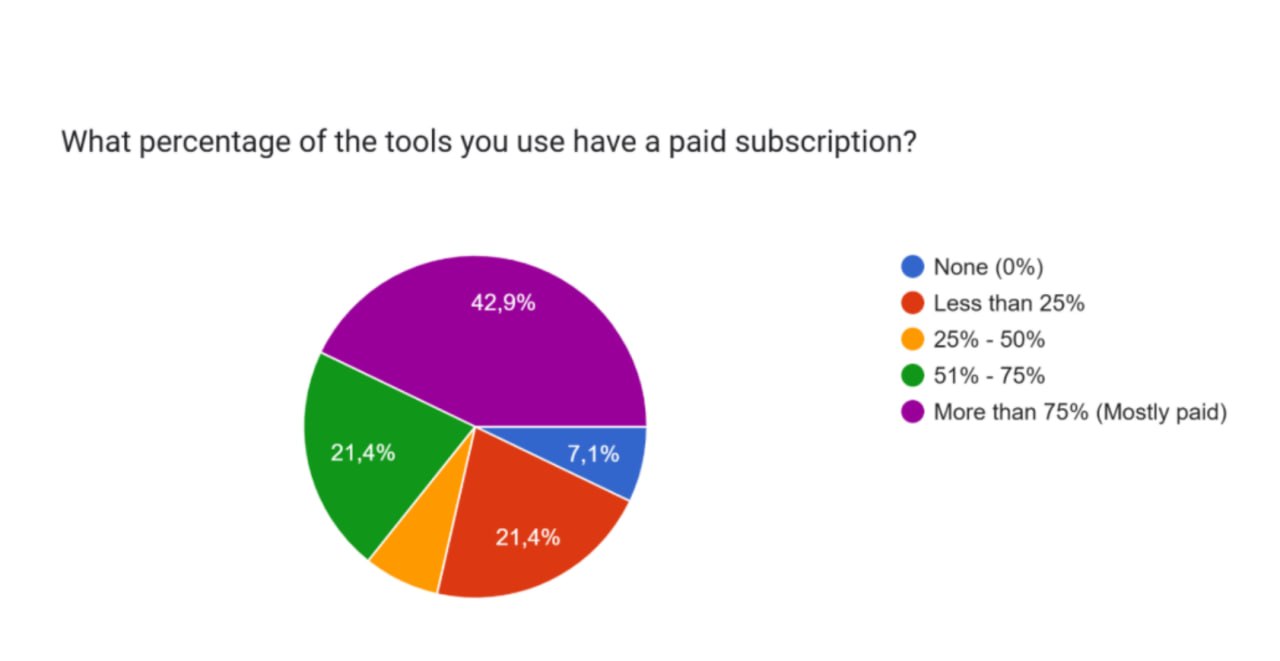
The picture is consistent at the ground level. According to probusiness.media’s own survey of European business founders and technology leaders conducted for this report, all 14 respondents use AI in some capacity — 86% actively, 14% occasionally. Yet depth of commitment varies sharply: 43% already run predominantly paid AI stacks (over 75% of tools on commercial subscriptions), signaling a clear shift from free experimentation to operational expenditure. The remaining gap is not access — it’s integration.
To understand what that transition actually looks like, probusiness.media conducted in-depth technical briefings with frontline practitioners, Chief Technology Officers, and AI founders. Their insights map the path enterprises must navigate across three interlocking challenges: infrastructure integrity, data quality, and human governance — the Trust Triad of modern automation.
The defining shift of 2026 is the Agentic Pivot: the deployment of autonomous, goal-directed AI systems capable of perceiving their environment, reasoning through multi-step logic, and interacting with heterogeneous software tools without human prompting.
The theoretical foundations of agent-based computing are decades old. What’s new is the combination of exponential advances in contextual reasoning and standardized interoperability protocols — most notably Anthropic’s Model Context Protocol — that have finally made production-scale deployment viable.
Volodymyr Zhukov, serial entrepreneur, Board Advisor, digital transformation consultant, Ingest AI Labs
“Conceptual AI architecture didn’t just materialize overnight. Back in 2011, my technical background was centered on building a multi-agent system designed to simulate and model complex municipal transport flows in Kharkiv. The market infrastructure and compute capacity simply weren’t there yet. What we are executing in 2026 is a fundamental break from the old generative content era. We have migrated to advanced reasoning models that can autonomously ingest a high-level corporate directive, decompose it into parallel execution workstreams, self-correct through recursive chain-of-thought processing, and deliver deterministic business outcomes.”
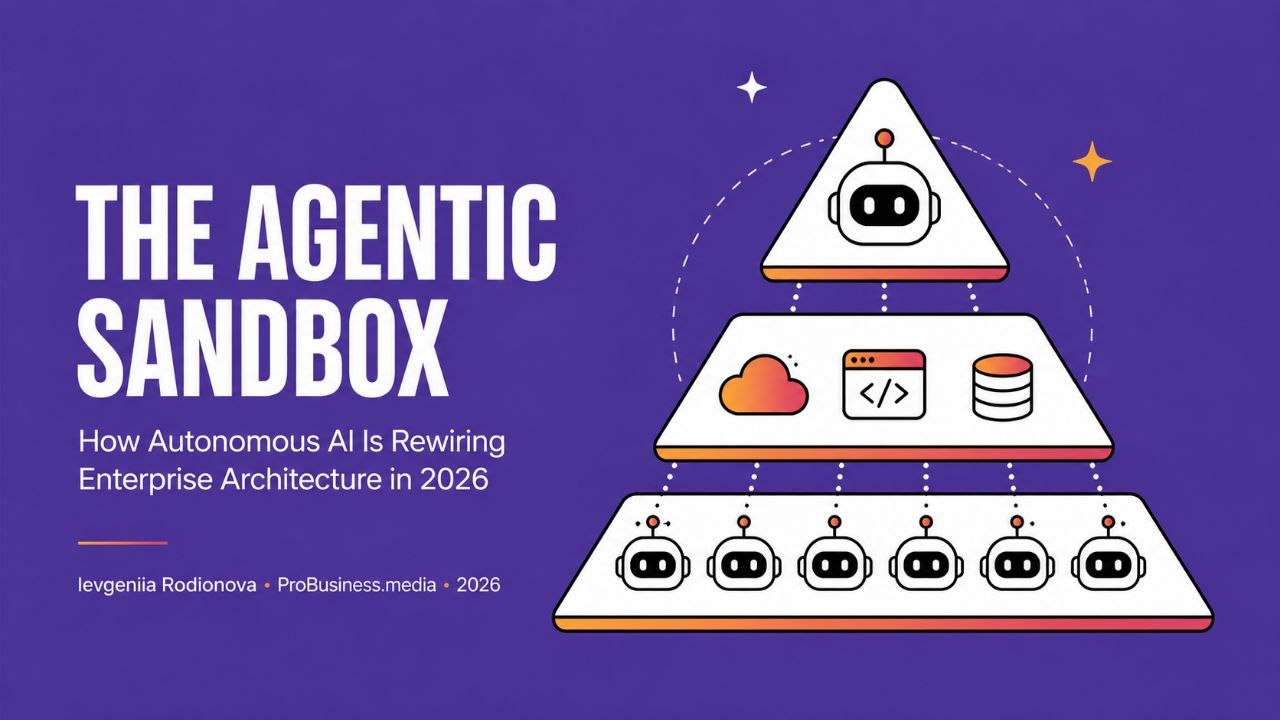
To manage this velocity without triggering cascading failures, the enterprise tech stack has stabilized around a tiered Agentic Pyramid:
High-reasoning foundation models that process strategic intent, plan long-horizon workflows, and manage human escalations.
Specialized sub-agents that use open connection protocols to query secure databases, legacy ERP systems, and external APIs.
Ultra-fast, distilled models optimized for atomic tasks — real-time data parsing, ingestion, transcription.
The economics of agentic AI have dismantled the traditional SaaS financial playbook. Monolithic SaaS providers historically enjoyed massive gross margins because the marginal cost of serving an additional user approached zero.
Autonomous agentic systems work differently. They don’t sit idle — they continuously evaluate context and execute actions, driving what economists are now calling the Inference Inversion. In 2026, inference workloads account for approximately two-thirds of all AI compute demand, up from roughly one-third in 2023, turning AI from a capital expenditure into a dynamic operational cost.
Despite that volatility, technology leaders are pressing forward — because the efficiency gains directly re-engineer product and R&D pipelines.
Anastasiia Orovetska, Head of TMetric:
“We are already seeing measurable productivity gains across product engineering workflows by integrating AI into development, QA, and product operations. One practical example is using Model Context Protocol connectors to connect our design system from Figma directly with AI-assisted frontend implementation workflows. This significantly reduces manual handoff effort between design and engineering teams and helps accelerate UI delivery while improving consistency. At the same time, effective AI adoption requires secure and well-structured internal infrastructure. Companies need clear governance, isolated environments, and thoughtful data handling policies to protect proprietary code and business-critical information.”
The survey data reflects this shift in spending behavior. Among the European founders surveyed by probusiness.media, the three most-used platforms were Google Gemini (86%), ChatGPT (79%), and Claude (79%) — with 64% of respondents spending the majority of their AI budget on paid subscriptions. Free-tier experimentation is giving way to committed infrastructure spend.
Qualitative business processes — strategic market discovery, customer research — are seeing structural bottlenecks removed at similar speed.
Ciarán Harris, Founder & CEO at CogniStream.ai:
“I’ve spent 25 years working in UX research and design, leading call projects for platforms like Google and Shopify. Historically, a scaled qualitative study was an operational bottleneck: 12 to 15 interviews took 6 to 8 weeks and cost about €25,000. Today, our voice platform automates these interviews globally, understanding the tone of voice and speaking multiple languages. Just a couple of weeks ago, we completed 160 interviews — 80 in the US and 80 in Germany — in the space of 10 days. This doesn’t take away anyone's job; it helps researchers run projects faster and cheaper, eliminating the massive scheduling and logistics overhead.”
The primary friction point preventing widespread enterprise scaling is no longer cultural resistance — it’s architectural data fragmentation. According to PYMNTS Intelligence research, 63% of technology executives cite data quality, availability, or fragmentation as a definitive barrier to AI performance. The probusiness.media founder survey echoes this: 43% of respondents agreed that AI poses a potential risk to data security — even among founders who are actively expanding their AI use. Autonomy requires clean, indexed, accessible context. Most legacy enterprises have none of it.
Olena Kleiner, Founder & CEO at Salesdep.ai:
“The single greatest challenge when deploying autonomous sales and support agents into an enterprise is the state of their internal data. Companies read about the agentic revolution and assume they can deploy overnight. But once you audit the infrastructure, you encounter a complete mess. Critical organizational knowledge isn’t indexed — it lives in the heads of siloed employees, or it’s fragmented across incompatible platforms. If your data foundation is broken, an autonomous system will simply scale that chaos at machine speed.”
This systemic problem stems from treating AI as deterministic software rather than a probabilistic, inference-driven loop.
Volodymyr Zhukov (Ingest AI Labs)
“Boardrooms consistently misclassify AI as a typical software solution — a plug-and-play procurement exercise. But an autonomous agent is an ongoing architectural transformation. It is entirely dependent on continuous data loops: what goes in natively dictates what comes out. Without dismantling and rebuilding your workflows to be agent-compatible, you are pasting expensive cognitive patches onto legacy structural bottlenecks.”
The macroeconomic consequences of cognitive automation are already visible in hiring data. McKinsey and Deloitte indicators show that routine, junior-level data processing roles are being systematically phased out.
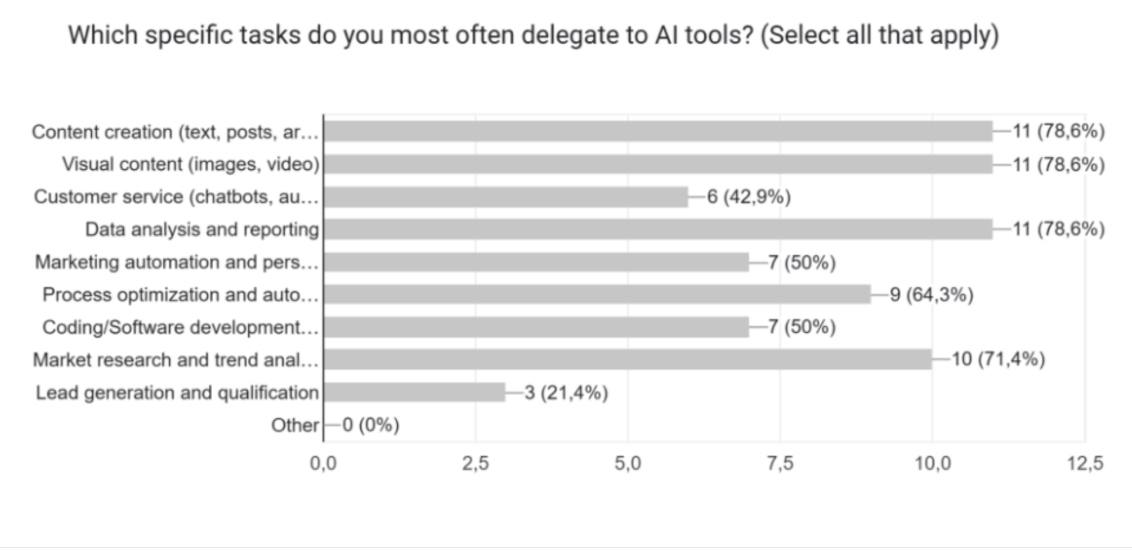
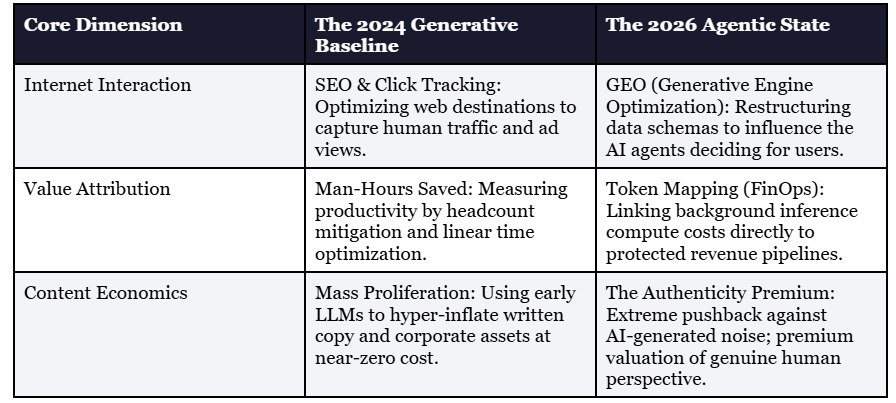
But the productivity shock has also triggered an existential crisis in content economics and digital marketing. Among the European business founders surveyed by probusiness.media, content creation — text, posts, articles — ranked as the single most delegated AI task, cited by 79% of respondents. Visual content production and data analysis tied at the same level. The tools that accelerated output are now directly feeding the saturation problem they helped create.
As low-cost generative production becomes commoditized, the competitive value of purely repetitive cognitive work is beginning to erode across multiple industries. Beneath the immediate productivity gains, however, a much larger economic transition is beginning to take shape.
Olena Kleiner, Founder & CEO at Salesdep.ai:
“AI’s ultimate economic role is to absorb the burden of routine value creation, stabilizing operational infrastructure so that human capital can be liberated. Rather than triggering mass displacement, this technology will allow professionals to break free from the exhausting, linear race for basic productivity. It forces a shift toward high-leverage human strengths: raw creativity, strategic synthesis, and deep relationship building. However, this transition will not be evenly distributed — organizations and leaders who master this agentic integration first will establish an unassailable competitive advantage.”
Agentic systems are changing more than just team structures — they’re redefining what a company actually needs to scale. Functions that previously depended on entire departments, from software engineering and outbound marketing to customer service and daily operations, can now be coordinated through interconnected AI agents overseen by one specialist. As a result, businesses are able to operate with far leaner teams while maintaining speed, consistency, and output at a level that once required significantly larger organizations.
Olena Kleiner, Founder & CEO at Salesdep.ai:
“We are entering an era of the ultra-efficient solo founder. Recently, a prominent tech accelerator launched a cohort specifically for solo entrepreneurs building entire companies completely on their own using AI. A single individual now handles software engineering, marketing, and sales — roles that historically required massive, capital-intensive teams. The market is shifting toward proving that one human, augmented by a synchronized matrix of autonomous agents, can scale a viable enterprise from scratch.”
As public digital spaces fill with programmatic, machine-generated content, consumer sentiment is pivoting toward human-centric, high-trust environments.
Anastasiia Orovetska (TMetric):
“We’re also seeing a growing fatigue around purely AI-generated content. As AI-generated materials become easier to produce, authenticity and real expertise become more valuable, not less. In practice, this means strong brands will increasingly differentiate through transparent product thinking, expert-driven communication, and genuine human perspective - while AI becomes an enabling layer behind the scenes rather than the public face of the brand.”
Ciarán Harris (CogniStream.ai):
“I am firmly in the camp of a 'skeptimist' — a skeptical optimist. I am skeptical about some short-term societal issues, but I'm very optimistic that we can thrive as a society. Ultimately, I see a future where biological and mechanical machines work together for the benefit of both mankind and technology. But right now when it comes to everyday tasks, AI is very beneficial for getting to a good draft, but it never sounds like a specific personal style. This is where humans are genuinely better, it's currently very easy to recognize AI-generated writing. Now, and in the foreseeable future, humans will resonate better with other humans.”
To guide an enterprise through this transformation and escape pilot purgatory, the modern C-suite must move from building discrete IT integrations to establishing platform governance strategy. Based on the deployment patterns emerging across these enterprise implementations, three immediate imperatives stand out.
When individual corporate functions — HR, legal, marketing — independently procure or assemble isolated micro-agents, the result is a fragile, ungovernable internal architecture. Organizations must mandate unified API and gateway standards to ensure multi-agent orchestration remains secure, standardized, and auditable. Without this, the agent layer becomes as siloed as the data layer it was supposed to fix.
Traditional IT budgeting fails when applied to autonomous background inference. If an apex agentic workflow runs continuously to monitor supply chains or manage compliance risk, it consumes compute resources dynamically — not on a per-seat, per-month basis. Finance and technology teams must align under an AI FinOps model, mapping token consumption directly to specific operational outcomes or risk-mitigation goals.
Because large language models are inherently probabilistic — calculating statistical predictions rather than logical absolutes — they cannot be given unmonitored autonomy over mission-critical infrastructure.
Volodymyr Zhukov (Ingest AI Labs)
“Never allow a probabilistic model to operate without hard-coded software circuit breakers. A junior developer or an un-audited agent cannot be trusted to run wild in production — a small planning error compounds over time. High-stakes enterprise deployments require an immutable, rules-based safety layer encasing the AI. The machine should operate at speed within safe boundaries. Human seniority must remain firmly in the loop as the ultimate logical and ethical arbiter.”
The enterprises succeeding in this transition are not treating AI as a software feature or productivity assistant. They are rebuilding operational architecture around continuous machine reasoning, while redefining the role of human expertise inside those systems.
Market value in an agent-orchestrated economy will not belong to the organizations running the largest models. It will belong to those that can most effectively resolve the friction between machine speed and immutable human governance.

Got a story worth telling?
Be our next guest!
🎙️ Apply now to be interviewed or published on our platform.
Subscribe now for exclusive content and expert insights. Be the first to stay informed!

Probusiness Media is an independent editorial platform that explores the stories, strategies, and systems behind conscious entrepreneurship in times of change.
Where stories, strategy, and meaning come together.


