


Got a story worth telling?
Be our next guest!
🎙️ Apply now to be interviewed or published on our platform.


 BlogsArticlesAI WEEK 2026 in Milan: What Europe’s Largest AI Event Signals for Founders, SMEs, and Business Leaders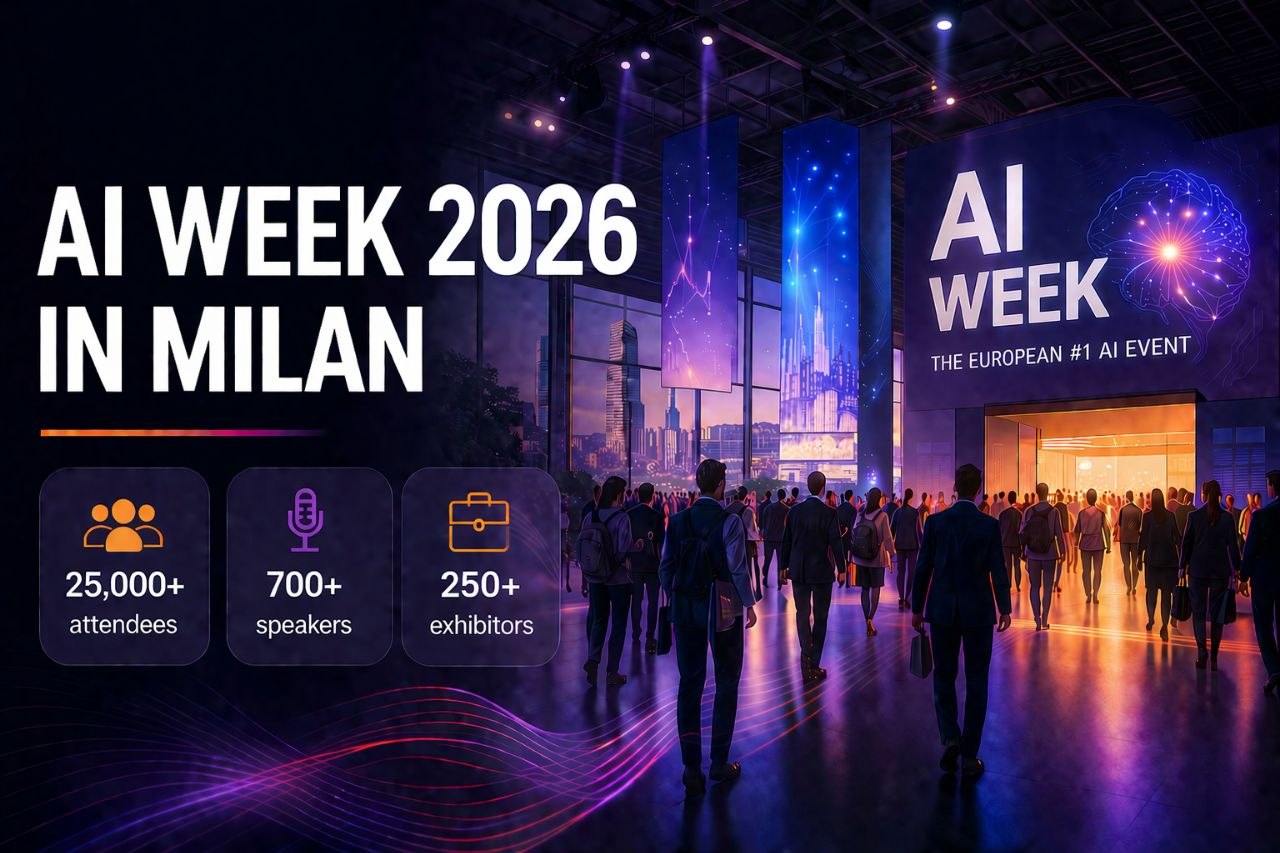
European companies are under pressure from two directions at once. They are expected to move faster on artificial intelligence, while also making more careful decisions about regulation, risk, and competitiveness. That is why AI WEEK 2026, scheduled for May 19 to 20, 2026, at Fiera Milano Rho in Milan, matters beyond the conference calendar. For founders, executives, SMEs, and transformation leaders, it offers a useful view of how the AI conversation in Europe is changing.
According to the organizers, AI WEEK 2026 is positioned as Europe’s leading event dedicated to artificial intelligence. They state that the 2026 edition will bring together more than 25,000 attendees, over 700 speakers, and 250 exhibitors working in the AI sector. The stated program focus includes industrial transformation and competitiveness, European regulation and geopolitical scenarios, and AI adoption in business and services.
Those details matter not only because of the event’s scale, but because of what they reveal about the next phase of AI in Europe.
A few years ago, many businesses treated AI as a side conversation. It lived in innovation teams, experimental pilots, or presentations full of ambition and very little operational consequence.
That phase is ending.
For European companies, AI is becoming a management issue, not just a technology topic. It affects productivity, service design, internal processes, compliance, decision-making, and competitive positioning. In other words, it is moving closer to the center of the business.
This is what makes AI WEEK 2026 relevant. Based on the organizers' agenda, the event reflects a wider shift from AI as experimentation to AI as execution.
That shift changes the audience.
This is no longer only a space for data scientists, AI vendors, or technical teams. It is increasingly relevant for founders deciding where to invest limited resources, for executives rethinking operations, for SME owners trying to stay competitive, and for professionals responsible for turning broad AI ambitions into something workable inside a real organization.
From AI experimentation to business execution
The most important signal in the AI WEEK 2026 agenda is not its size. It is the nature of the themes attached to it.
According to the source material, the event will focus on the impact of artificial intelligence on the economy, industry, information, public policy, and society. That is a much wider frame than product demos or trend forecasting. It suggests that AI is being discussed as infrastructure for business and policy, not just as a toolset.
For European business leaders, that changes the questions worth asking.
The core challenge is no longer simply whether to use AI. The harder questions are more practical:
Where does AI create measurable business value?
Which functions should adopt it first?
How should companies balance speed with compliance?
What does AI readiness actually look like beyond internal enthusiasm?
How should SMEs and scale-ups think about competitiveness when larger players have more capital and capability?
These are not abstract questions. They are operational ones.
AI is often discussed as a global race, but European companies operate under specific conditions. That is why a major AI event in Milan matters differently than a general technology conference elsewhere.
In Europe, AI adoption is shaped not only by market opportunity but also by regulation, industrial policy, geopolitical uncertainty, and fragmented business environments. That makes the conversation more demanding and, in many ways, more relevant to actual leadership decisions.
The organizers' emphasis on European regulation and geopolitical scenarios is especially telling. Regulation is no longer something companies can treat as a late-stage legal review. It increasingly affects how organizations plan adoption, assess vendors, think about risk, and define responsibility across teams.
The same applies to competitiveness. When a major event places industrial transformation and competitiveness at the center of the agenda, it suggests that AI is being understood less as a novelty and more as part of Europe’s business and industrial future.
For founders and executives, that is the real story.
According to the organizers, AI WEEK 2026 aims to bring together key players from the international AI ecosystem. If the event delivers on its stated scale, it will be one of the most visible AI gatherings in Europe in 2026.
But scale alone is cheap if there is no substance behind it.
What gives AI WEEK 2026 more strategic relevance is the combination of size and agenda. The organizers are not presenting it only as a showcase for AI tools. They describe it as a platform for analyzing the broader impact of AI on business, industry, policy, and society.
That makes the event potentially useful for several business audiences:
Founders and startup leaders
They should pay attention because AI is increasingly tied to efficiency, positioning, and speed of execution. Events like this can reveal which parts of the market are moving from hype into actual operational relevance.
SME owners and managers
They should pay attention because the pressure to adopt AI is no longer limited to large corporations. Smaller companies are also facing questions about productivity, service delivery, process automation, and market competitiveness, often without the luxury of large experimentation budgets.
Executives and corporate decision-makers
They should pay attention because AI is becoming cross-functional. It affects operations, customer experience, governance, commercial strategy, and organizational design. It is not something that can remain isolated inside IT.
Innovation, strategy, and transformation professionals
They should pay attention because large events often show where client priorities, budget conversations, and implementation expectations are heading next.
AI adoption in Europe is becoming cross-functional
One of the most important business shifts reflected in AI WEEK 2026 is this: AI adoption is no longer just technical deployment.
It is organizational adoption.

Got a story worth telling?
Be our next guest!
🎙️ Apply now to be interviewed or published on our platform.
Subscribe now for exclusive content and expert insights. Be the first to stay informed!

Probusiness Media is an independent editorial platform that explores the stories, strategies, and systems behind conscious entrepreneurship in times of change.
Where stories, strategy, and meaning come together.


