

Got a story worth telling?
Be our next guest!
🎙️ Apply now to be interviewed or published on our platform.


 BlogsArticlesAI WEEK 2026 in Milan: Why Europe’s Largest AI Event Matters for Business, Media and Policy
AI WEEK 2026: Why Milan Is Becoming One of Europe’s Key AI Meeting Points
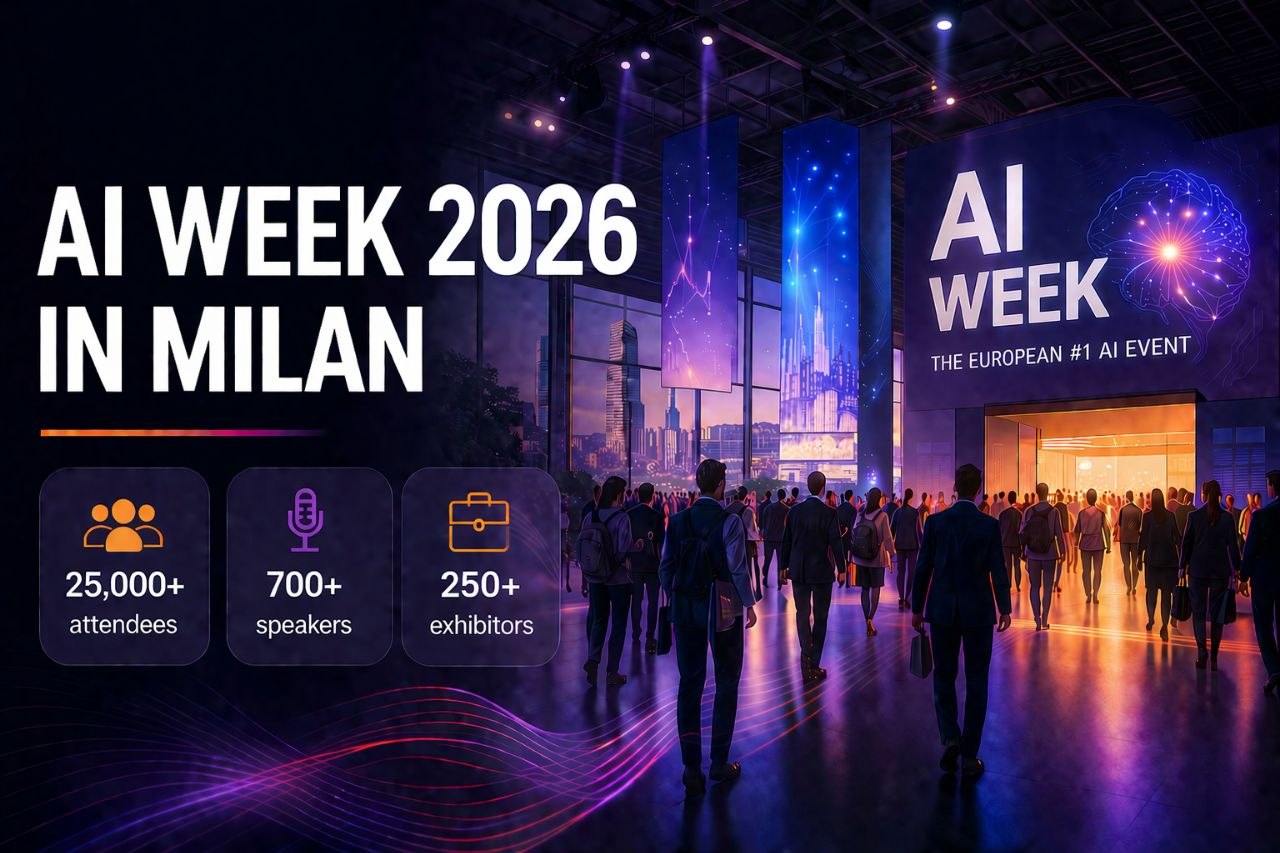
Artificial intelligence is no longer a conversation limited to engineers, labs or product teams. It is now shaping strategy in boardrooms, public policy, media, healthcare and cybersecurity. That broader shift is exactly what AI WEEK 2026 is trying to capture as it returns to Milan on May 19-20 at Fiera Rho. The event presents itself as Europe’s largest gathering dedicated to artificial intelligence and is aimed at managers, entrepreneurs and professionals looking to understand how AI can be applied in real business settings.
Scale is part of the story. According to the official event website, AI WEEK 2026 is expected to welcome more than 25,000 attendees, feature over 700 international speakers across multiple stages, and host more than 250 exhibitors active in the AI sector. That makes it less of a niche conference and more of a high-density meeting point for the wider AI economy.
What gives the event business relevance is its framing. AI WEEK is not presented simply as a showcase of tools or product launches, but as a platform for understanding how artificial intelligence is changing competitiveness, operating models and decision-making across industries. The official program emphasizes practical sessions, case studies, training and networking, suggesting a strong focus on adoption rather than spectacle alone.
The structure of the 2026 edition reinforces that practical angle. This year’s program includes five thematic summits: Startup, Marketing, Cybersecurity, Healthcare and Sport. Each track is positioned around applied use cases rather than abstract discussion. The Marketing summit, for example, focuses on tools, live demos and real cases for marketers and communicators, while the Cybersecurity and Healthcare tracks explore operational risks, concrete solutions and sector-specific transformation.
That matters because the European AI conversation has changed. The core question is no longer whether AI will affect business. It is where adoption is moving fastest, which functions are changing first, and how companies can balance experimentation with governance, security and trust. An event built around sectors rather than slogans is more useful for decision-makers trying to answer those questions. This is an inference based on the program structure and positioning presented by the organisers.
The speaker lineup adds further weight. The official site highlights names such as Karen Hao, Llion Jones, Rong Yan, Gian Segato, Minh Pham, Advait Sarkar, Nataliya Kosmyna, Michele Catasta, Mark Hamilton, Elena Verna and Nic Newman, alongside participants from companies and institutions including Anthropic, Perplexity, Replit, Google and the Reuters Institute. That creates a mix of research, product development, growth, media and applied AI perspectives in one place.
For business media, this mix is particularly valuable. It means the event is not only about what AI can do, but also about how AI is being interpreted, commercialized, regulated and communicated. In practice, that turns AI WEEK into more than a conference calendar item. It becomes a useful lens on where Europe’s AI debate is heading and which narratives are gaining traction across industries. This interpretation is drawn from the sectors, speakers and audience profile described by the organisers.
The audience profile reflects the same breadth. AI WEEK is described as an event for entrepreneurs, managers and professionals, while also offering networking spaces, exhibitor areas, practical training, live demos and community meetups. That suggests a cross-functional environment where corporate buyers, startups, technical experts, communicators and institutional actors can all collide in the same space.
For companies, that makes the event relevant in a very practical way. It offers a chance to see which AI products are being pushed into the market, how different sectors are translating AI into workflows, and where the next competitive pressure may come from. For journalists and editors, it offers a concentrated snapshot of the overlap between technology, business, media and policy that increasingly defines the AI story in Europe. This is an inference supported by the event’s exhibitor footprint, summit structure and audience positioning.
If AI WEEK 2026 delivers on its promise, Milan will host more than a major tech event. It will host a compressed view of Europe’s AI moment: ambitious, commercial, highly visible and increasingly shaped by the need to connect innovation with real-world adoption.

Got a story worth telling?
Be our next guest!
🎙️ Apply now to be interviewed or published on our platform.
Subscribe now for exclusive content and expert insights. Be the first to stay informed!

Probusiness Media is an independent editorial platform that explores the stories, strategies, and systems behind conscious entrepreneurship in times of change.
Where stories, strategy, and meaning come together.


